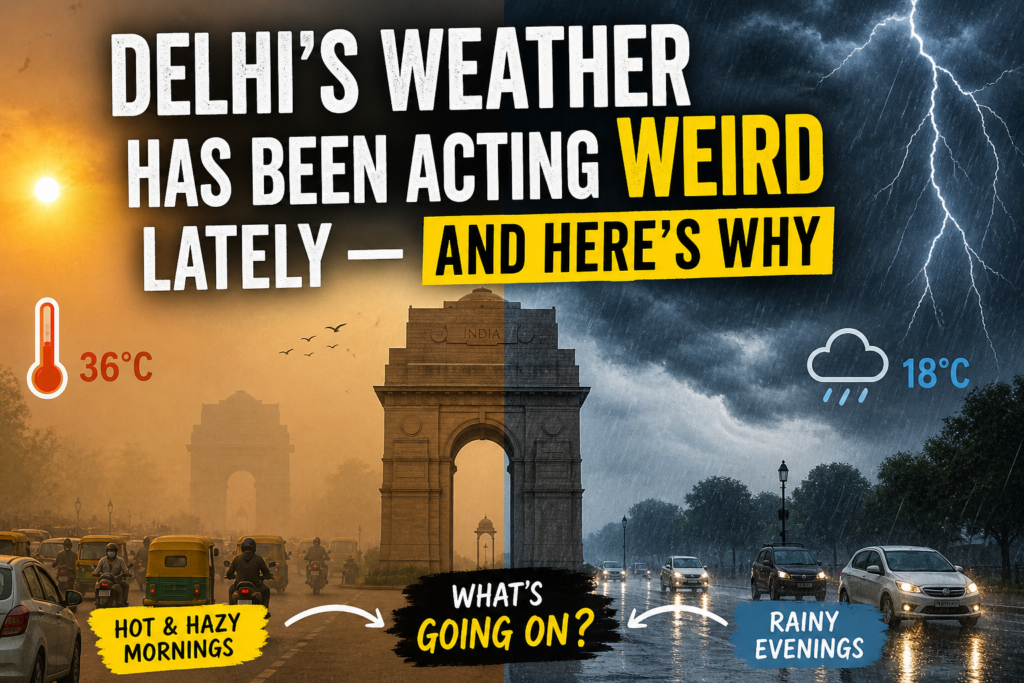
Delhi’s Weather Has Been Acting Weird Lately — And Here’s Why
Step outside in Delhi right now and you’ll feel it immediately. That strange mix of suffocating heat, a sudden dusty wind, and then — out of nowhere — clouds rolling in like they own the place. One minute you’re sweating through your shirt, and the next you’re wondering if you should’ve brought an umbrella. If you’ve been feeling confused about what’s going on with Delhi’s weather lately, you’re absolutely not alone.
Right now, as of today (April 29, 2026), Delhi is sitting at around 90°F (32°C), partly sunny, with temperatures expected to shoot up to 100°F (38°C) by tonight. Tomorrow brings a 40% chance of rain. Saturday? Back to near 100°F. It’s all over the place. And honestly, that inconsistency is exactly the problem — and the story.
So What Is Actually Happening?
Let’s be real for a second. Delhi has always had brutal summers. That’s nothing new. But this sudden back-and-forth — extreme heat one day, dust storms the next, unexpected showers after that — that’s a pattern that’s been getting more intense with each passing year.
Here’s what’s driving it:
Western Disturbances acting up. These are basically moisture-carrying wind systems that originate from the Mediterranean region and travel eastward. When they interact with the dry, hot air mass sitting over North India right now, they create this chaotic push-and-pull of weather. That’s why you get random cloudy spells and brief rain showers even in peak summer.
The pre-monsoon transition phase. April-May is that awkward in-between period where winter is long gone but monsoon hasn’t arrived yet. The atmosphere is unstable. Hot surface air rises rapidly, cool air from upper levels rushes in, and that clash creates thunderstorms, dust storms (locally called aandhi), and sudden temperature drops — sometimes of 8–10 degrees within an hour.
Urban Heat Island effect. This one’s a Delhi special. With endless concrete, vehicles, AC units pumping out hot air, and very little green cover in many areas — Delhi essentially generates its own heat. The city is measurably hotter than surrounding rural areas, sometimes by 4–5 degrees. So even when nature tries to cool things down a bit, Delhi’s urban setup fights back.
Climate patterns shifting. Look, no one wants to be the person who blames everything on climate change, but the data is hard to ignore. The frequency of extreme heat days in Delhi has increased significantly over the past decade. Heat waves that used to last 3–4 days now stretch to a week or more. The monsoon itself has become unpredictable — arriving late, leaving early, or dumping too much rain in too short a time.
What It Actually Feels Like Living Through It
If you live in Delhi, you already know this in your bones. You plan to go out at 6 PM because it should be cooler, but the heat radiating from the roads makes it feel like standing next to an open oven. You drink water constantly but still feel dehydrated. Your sleep is wrecked because nighttime temperatures barely drop.
And then there’s the dust. Oh, the dust. A aandhi rolls in with zero warning — suddenly visibility drops, your eyes are burning, and every surface in your house is covered in a fine layer of grit within minutes. Then it’s gone. And the heat comes back.
It’s exhausting in a way that’s hard to explain to someone who hasn’t experienced it.
Precautions You Actually Need to Take (Not the Generic Stuff)
Okay, so here’s the practical part. And I’m not going to give you the boring “drink 8 glasses of water” advice — let’s talk about what actually matters.
Timing is everything. Between 11 AM and 4 PM, the sun is ruthless. If you can avoid being outside during these hours, do it. If you can’t — because most of us have jobs and lives — cover up properly. A light cotton dupatta or scarf wrapped around your head and neck does more than you’d think.
ORS is your friend. Water alone isn’t enough when you’re sweating this much. You’re losing salts and electrolytes rapidly. Keep ORS packets or nimbu-paani with a pinch of salt and sugar. It sounds old-fashioned, but it genuinely works better than any fancy sports drink.
Watch for heat exhaustion signs. This one’s serious. If you or someone around you is feeling dizzy, confused, has stopped sweating despite the heat, or has skin that looks red and dry — that’s heat stroke territory and it’s a medical emergency. Get them to a cool place and call for help immediately. Don’t wait it out.
Before a dust storm: When you see that yellow-brown wall of dust approaching on the horizon, you have maybe 10–15 minutes. Close all windows and doors. Wet a cloth and keep it near ventilation points. Get your vehicles inside if possible. The fine particulate matter in these storms is genuinely harmful to lungs — especially for kids, elderly people, and anyone with asthma.
After rain — be careful. The rain feels like relief, but post-rain humidity in Delhi is oppressive and the heat returns fast. Roads get waterlogged. More importantly, stagnant water becomes a breeding ground for mosquitoes almost immediately. Use repellents, clear any water collection around your home, and don’t let kids play in flooded streets (the water is almost always contaminated).
Sleep and rest matter more than you think. Heat stress accumulates. If you’re not sleeping well because of the heat, your body’s ability to cope with the next day’s heat drops significantly. Use fans, keep windows open at night when it’s cooler, avoid heavy meals close to bedtime, and if you have AC — a moderate temperature like 26°C is healthier than blasting it at 18°C.
Mental health check. This sounds random, but extreme heat genuinely affects mood, cognitive function, and aggression levels. Studies have shown this. If you’re feeling unusually irritable or foggy — it might not just be stress. It might literally be the heat. Give yourself a break, stay cool when you can, and check on older relatives and neighbours who might be struggling silently.
The Bigger Picture
Delhi’s weather chaos right now isn’t random. It’s a sign of larger systems shifting — climatically, environmentally, and in terms of how we’ve built and run this city. The immediate fixes are the precautions above. But the long game involves more trees, better urban planning, reduced emissions, and honestly — taking these warnings seriously instead of just waiting for monsoon to bail us out.
For now though? Stay hydrated, watch the sky, and maybe keep an umbrella and a water bottle with you at all times. With Delhi weather in late April, you genuinely never know what the next hour holds.
Stay safe out there.