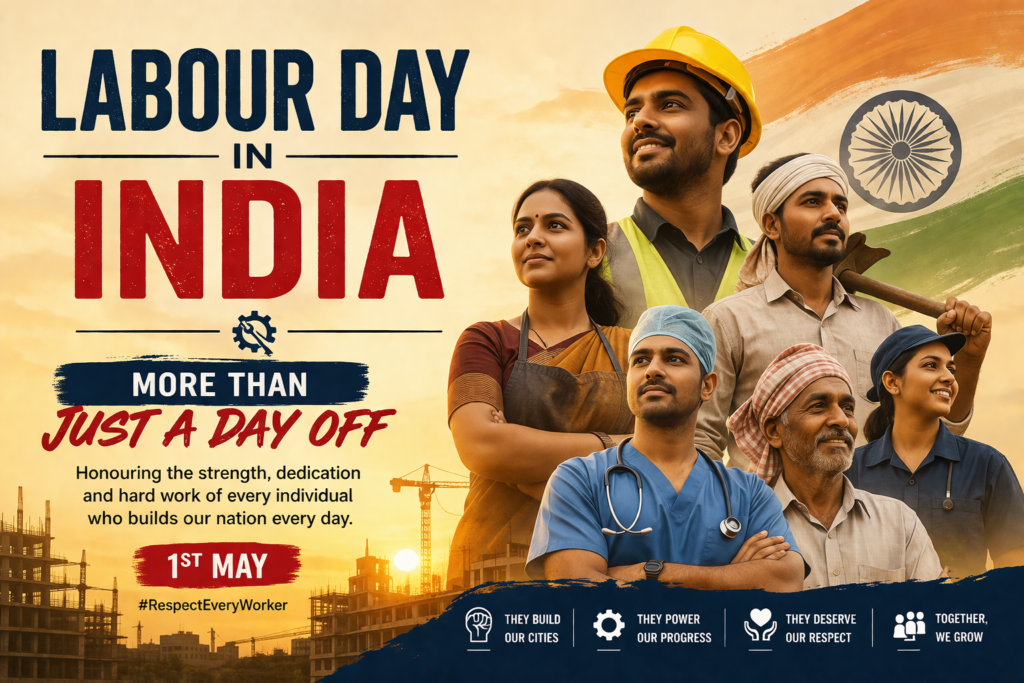
Labour Day in India — More Than Just a Day Off
Every year on May 1st, something quietly powerful happens across India. Factory sirens fall silent. Trade union banners go up in the streets. Old Marxist anthems crackle from loudspeakers in Tamil Nadu. Construction workers sit together sharing chai. Garment factory workers in small towns get a rare day to sleep in, eat a home-cooked meal, and breathe. No deadlines, no supervisors, no overtime.
For most working Indians, May 1st — Labour Day, or as it’s officially called, Antarrashtriya Shramik Diwas — is that one day in the calendar that actually belongs to them.
But here’s the thing. A huge chunk of Indians treat it as just another public holiday — banks closed, schools shut, maybe a family outing if the weather is nice. And that’s fine, honestly. Rest is the whole point. But if you pause for a moment and look at how Labour Day is actually observed across different corners of this country, you’ll find something genuinely moving — a patchwork of traditions, rallies, cultural events, and quiet moments of recognition that together tell a story about who built this country and what they deserve.
How It All Started in India — Chennai, 1923
Before we get into the celebrations, a quick detour to where it all began in India — because this part is not taught enough in schools.
The first Labour Day celebration in India took place in Chennai (then Madras) in 1923, under the Labour Kisan Party of Hindustan. The leader, Malayapuram Singaravelu Chettiar — a communist, a lawyer, and a fierce workers’ advocate — raised the red flag for the first time in India that day and demanded that the government declare May 1 a national holiday to recognise workers’ rights.
The event was held on the beach and later outside the Madras High Court, where workers raised demands for shorter working hours, better pay, and social justice.
That was over a hundred years ago. And the spirit of that day — loud, defiant, hopeful — is very much alive in how Labour Day is celebrated in Tamil Nadu even today.
The Celebrations Across India — A State by State Story
What makes Labour Day in India so interesting is that it doesn’t look the same everywhere. Different states, different cultures, different histories — the celebrations reflect all of it.
Tamil Nadu is probably where Labour Day feels the most alive and politically charged. Trade union rallies, cultural events, and government-led programmes aimed at recognising the dignity of labour mark the day across the country, but Tamil Nadu leads with particular intensity. Chennai sees massive processions — workers from different unions marching together, red flags everywhere, speeches about wages and rights, cultural performances, and folk songs that have been sung at these rallies for generations. The atmosphere is part protest, part festival, and entirely passionate.
Maharashtra and Gujarat have a completely unique relationship with May 1st — because it’s not just Labour Day for them. Today, May 1 remains a public holiday in several states and often coincides with regional celebrations — Maharashtra Day honours the formation of the state of Maharashtra on May 1, 1960, following the division of Bombay State, and Gujarat Day marks the official creation of Gujarat on the same day in 1960. So for Mumbaikars and Ahmedabadis, the day is a double celebration — workers’ rights AND state pride. You get rallies with union flags alongside cultural programmes celebrating Marathi and Gujarati identity. It’s a full day out.
Kerala — no surprises here — goes all in. The state with the most organised labour movement in India treats May Day with the seriousness of a major festival. Red flags fly from rooftops. The streets of Thiruvananthapuram, Kochi, and Kozhikode fill up with processions from the crack of dawn. Party offices of the Left hold public meetings. There are speeches, there’s music, there are garlands placed on portraits of labour leaders past and present. In Kerala, May Day isn’t just observed — it’s felt.
West Bengal follows a similar pattern. Kolkata, with its deep leftist political history, sees some of the most energetic May Day marches in the country. Brigade Parade Ground rallies draw lakhs of workers. Political leaders address huge crowds. The red of the flags and the noise of the slogans fill the city’s famous streets.
Delhi and the North tend to be a bit quieter — more institutional, less festive. Central and state government departments hold formal events. Trade unions organise seminars and press conferences about workers’ issues. There’s less of the cultural celebration and more of the political discourse. But the sentiment — recognising the contributions of India’s vast working class — is the same.
The Traditions That Make May Day Special
Beyond the rallies and speeches, Labour Day in India has some beautiful, simple traditions that have been passed down over decades.
The Red Flag is the most iconic symbol of May Day across the world — and India is no different. In states where labour movements are strong, the hoisting of the red flag on May 1st morning is a ritual that workers take seriously. It’s not just a party symbol — it represents the blood, sweat, and struggle of every worker who ever fought for their rights.
Felicitation of Workers — in many organisations, trade unions, and government departments, Labour Day is the occasion to formally recognise workers who have put in years of service. Simple ceremonies where workers receive certificates, shawls, or small mementos — nothing grand, but the acknowledgement matters more than the gift.
Cultural programmes and folk performances are a big part of May Day in South and East India in particular. In Tamil Nadu, Koothu and street plays dramatise the struggles of working-class communities. In West Bengal and Kerala, songs and performances rooted in labour movement history are a cherished tradition. These aren’t just entertainment — they’re a way of keeping the stories alive for younger generations who might otherwise forget what was sacrificed to get them an 8-hour workday.
Seminars and awareness events have become more prominent in recent years — especially in cities. Trade unions, NGOs, and civil society groups hold discussions about minimum wages, gig worker rights, workplace safety, and the challenges facing migrant workers. For many across India, May 1 serves as a symbolic day of rest, while it is also a time when trade associations and civil society groups host seminars and parades to address modern employment challenges, ensuring that the legacy of the 1923 movement continues to influence current labour policy and advocacy.
Sharing food with workers is a tradition that’s more informal but deeply meaningful. In many households — especially in cities — May Day is a day where employers or families consciously reach out to their domestic workers, construction workers, or factory staff to give them not just a day off but a small token of appreciation. A box of sweets, a meal together, an extra day’s pay. Small gestures that carry a lot of weight.
This Year’s Theme — And Why It Hits Different
The theme for Labour Day 2026 is “Ensuring a Healthy Psychosocial Working Environment.” That might sound like corporate jargon at first glance, but think about what it actually means in the Indian context.
We’re talking about a country where a garment worker in Surat sits at a machine for 10 hours a day. Where a delivery rider is expected to be on call 24/7 with zero job security. Where a software engineer in Bengaluru pulls 70-hour weeks because the startup culture glorifies overwork as hustle. Where a domestic worker in a Delhi apartment doesn’t even have a formal contract, let alone a mental health benefit.
In 2026, Labour Day is particularly relevant for modern workplaces, where remote work, gig jobs, and fast-changing technology have transformed how people earn a living. The theme of mental well-being highlights the need to reduce stress, avoid burnout, and ensure fair contracts and benefits even for part-time and platform workers.
The fact that this year’s theme is about psychosocial health — stress, dignity, burnout, toxic workplaces — tells you that the labour movement has evolved. It’s no longer just about 8-hour workdays and minimum wages. It’s about whether your job makes you feel human.
What Labour Day Means in Everyday India
Here’s something worth sitting with. India has one of the largest workforces in the world — over 500 million people. The overwhelming majority of them work in the informal sector. No written contracts. No EPF. No paid leave. No sick days. No Workers’ Day off, ironically. They work on May 1st because they have to.
For these workers — the street vendor, the construction labourer, the domestic helper, the roadside mechanic — Labour Day isn’t a celebration. It’s a reminder of how far there is still to go.
That’s what makes the day worth more than just a national holiday notification on your phone. The rallies, the speeches, the red flags, the cultural events — they’re all saying the same thing: the people who build our buildings, sew our clothes, cook our food, drive us home, clean our offices — they matter. Their time matters. Their dignity matters.
How You Can Mark the Day Meaningfully
You don’t have to go to a rally or wave a red flag to honour Labour Day — though those are entirely valid choices. Some simpler, more personal ways to mark the day:
Give your domestic help, driver, or building security guard the day off — with pay. It costs you very little and means a lot to them. If you’re an employer or a manager, use this day to genuinely ask your team how they’re doing — not a performance check, just a human conversation. Take a moment to read about the history of the 1923 Chennai celebrations, or the Haymarket affair, or the story of India’s labour movement. It’s more inspiring than you’d expect.
And maybe, just maybe, resist the urge to send that work WhatsApp message on May 1st. Let people rest. It’s literally what the day is for.
Labour Day in India is a celebration, a protest, a tradition, and a reminder all rolled into one. It’s been observed for over a hundred years — first on a beach in Madras, now in streets and stadiums and seminar halls across the country. The faces have changed. The challenges have evolved. But the core demand remains exactly what it was in 1923.
Respect the worker. Value the labour. Protect the dignity.
Happy Labour Day. 🔴