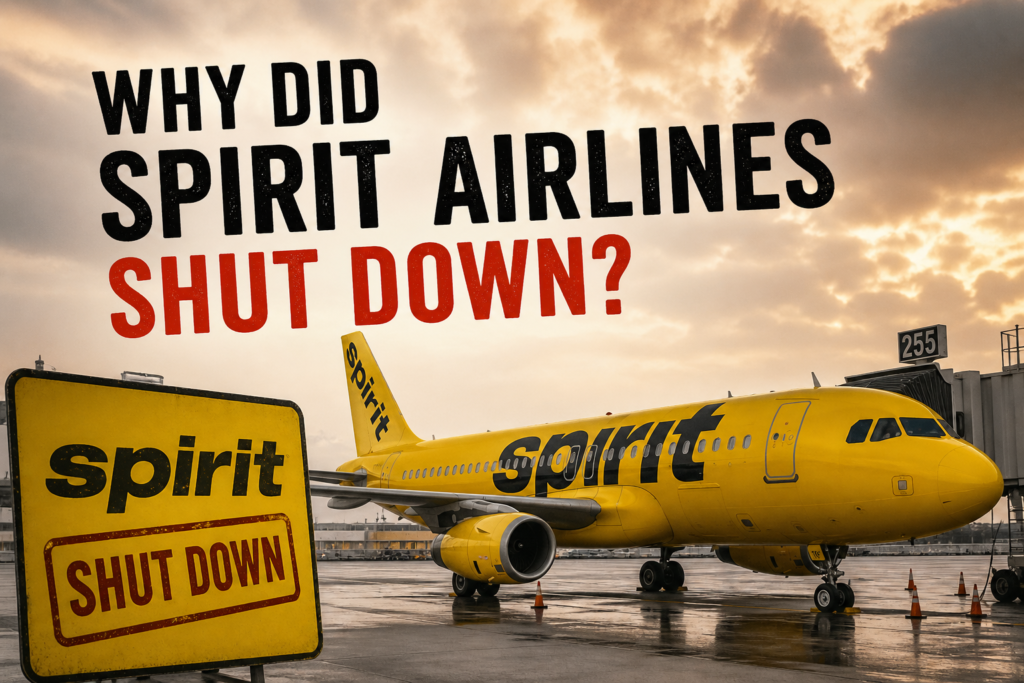
Spirit Airlines Is Gone — And Here’s the Real Reason Why
You’ve seen those bright yellow planes at the airport your whole life. Hard to miss, honestly. Spirit Airlines had a look, a brand, and a very specific promise — get you from Point A to Point B for as cheap as humanly possible. No frills. No free snacks. Barely enough legroom to cross your legs. But hey, $39 to Fort Lauderdale? You weren’t complaining.
Well, those yellow planes are grounded. For good.
On May 1, 2026, Spirit Airlines officially ceased all operations — immediately, with no warning to passengers mid-trip — after running out of cash and failing to secure either a government bailout or a loan from creditors to keep it alive. Around 17,000 employees lost their jobs overnight. Flights were cancelled across the board. And just like that, one of America’s most recognizable budget airlines was gone.
So what happened? The easy answer is “they ran out of money.” But that’s like saying a house burned down because there was fire. The real story is messier, more frustrating, and honestly — pretty fascinating if you’re into how businesses collapse under the weight of their own decisions plus some really bad luck.
Spirit Was Actually Doing Fine — Until It Wasn’t
Here’s something most people don’t know: Spirit was profitable. For years, actually. The ultra-low-cost carrier model worked. You charge almost nothing for the base ticket, then make your money back on bag fees, seat selection, snacks, carry-ons — basically everything that legacy airlines used to bundle into the ticket price. Spirit unbundled all of it, kept base fares razor thin, and attracted millions of price-sensitive American travelers who just needed a seat in the sky.
It was a smart model. And for a long time, it worked beautifully.
Then the pandemic hit in 2020. And while every airline suffered, Spirit’s specific model — built around volume, high aircraft utilization, and budget travelers — took a particularly brutal hit. Leisure travel collapsed. The price-sensitive customers Spirit relied on were the first to stop flying. And by the time travel came back, the world Spirit was returning to was fundamentally different from the one it had left.
The Merger Mess That Changed Everything
This is where the story gets complicated. And depending on your political leanings, you might read this differently — but here are the facts.
In 2022, Spirit first agreed to merge with Frontier Airlines — another ultra-low-cost carrier. The idea made some sense: two budget airlines combining to create scale and cut costs together. But then JetBlue swooped in with a bigger offer. A $3.8 billion acquisition deal. Spirit’s shareholders, smelling more money, voted to ditch Frontier and go with JetBlue.
Spirit’s own board warned shareholders that the JetBlue deal had serious regulatory problems. They said it out loud. But the shareholders got greedy and accepted the offer anyway.
Sure enough, the Biden administration’s Department of Justice sued to block the merger, arguing it would reduce competition and raise fares for budget travelers. A federal judge agreed in January 2024, and JetBlue walked away. Just like that, the $3.8 billion lifeline was gone.
Now look — there’s a real debate about whether that DOJ decision was right or wrong, and it’s become politically charged. Many Republicans argue that blocking the merger directly caused Spirit’s collapse. Many on the left argue the DOJ was protecting consumers. The truth, if you dig into the numbers, is somewhere in the middle.
Even if the JetBlue merger had gone through, JetBlue itself was losing money hand over fist. They had been paying pilots not to fly and scaling back their own fleet. The combined airline would likely have been a bigger, more indebted mess. As one aviation analyst put it bluntly: Spirit failed because it stopped evolving its business model and basically sat idle for years without making major changes — and that’s on Spirit’s leadership, not any administration.
The Big Airlines Learned Their Trick — And Used It Against Them
Here’s a part of the story that doesn’t get enough attention. Spirit’s entire business model depended on one thing: being significantly cheaper than everyone else. That price gap was their competitive advantage. Their reason to exist.
Then Delta, United, American, and Southwest all launched their own “basic economy” fares — stripped-down, cheap tickets with no frills, no changes, no nothing. Suddenly the gap between a Spirit fare and a Delta basic economy fare got a lot smaller. And when the gap shrinks, why would a traveler pick Spirit — with its reputation for delays, cramped seats, and nickel-and-diming — over a legacy carrier that at least has functioning airport lounges and a real frequent flyer program?
The major airlines essentially copied Spirit’s homework, undercut their margin, and watched them struggle. Harsh? Yes. Business? Absolutely.
Two Bankruptcies in Less Than a Year
By November 2024, Spirit filed for Chapter 11 bankruptcy — the first major U.S. airline to do so since 2011. A judge approved a reorganization plan in early 2025, and for a brief moment it looked like Spirit might actually survive in a leaner, restructured form.
That hope didn’t last long. In August 2025, they filed for bankruptcy again. The second filing in less than a year. By this point, Spirit had lost more than $2.5 billion since the start of 2020. That’s not a company going through a rough patch — that’s a company with a fundamental problem it couldn’t solve.
They had also been dealing with a completely separate nightmare: Pratt & Whitney engine issues that grounded a significant chunk of their fleet. Fewer planes flying means fewer tickets sold means less revenue coming in — at exactly the time they needed every dollar they could get.
The Iran War and the Fuel Crisis That Ended It
By early 2026, Spirit was trying to emerge from its second bankruptcy restructuring, hoping to come out the other side as a leaner airline. And then the U.S.-Israel military strikes on Iran happened.
Jet fuel prices doubled in some places almost overnight. For an airline already operating on the thinnest of margins, already deep in debt, already fighting to stay relevant — an 80% increase in fuel costs was simply unsurvivable. Spirit had expected to emerge from bankruptcy protection by mid-2026. That plan evaporated.
They went to the Trump administration asking for a bailout. Transportation Secretary Sean Duffy pushed back hard, warning that voters would see it as bailing out a failing company — noting correctly that Spirit was in deep trouble long before the Iran conflict. The bailout didn’t come. Creditors wouldn’t extend a loan either. And with no cash left and no rescue in sight, Spirit had no choice.
They shut down. Immediately. May 1, 2026.
What Happens to Passengers and Employees Now
If you had a Spirit flight booked — you’re out of luck, at least immediately. Spirit isn’t operating any flights and isn’t in a position to rebook or refund tickets through normal channels. Your best options right now are to dispute the charge with your credit card company, check if you purchased travel insurance, or look into whether the Department of Transportation will provide any consumer protections.
For the 17,000 employees — pilots, flight attendants, gate agents, mechanics, ground crew — this is devastating. These are real people with real bills, many of whom had been through the stress of two bankruptcies already, hoping their airline would pull through. Southwest Airlines has said it will offer discounted flights at airports on overlapping routes with Spirit, which is something — but it doesn’t replace 17,000 jobs.
So Who’s Actually to Blame?
Honestly? A lot of people and a lot of things.
Spirit’s leadership failed to adapt when the competitive landscape changed. The shareholders who overruled their own board to chase JetBlue’s money made a bet that backfired catastrophically. The Biden DOJ’s merger decision — right or wrong on antitrust grounds — removed a potential lifeline. The pandemic hollowed out their customer base at the worst possible time. The big legacy airlines copied and undercut their model. The Pratt & Whitney engine issues grounded their planes. And the Iran war spiked fuel costs at the exact moment Spirit needed a miracle.
No single villain. Just a slow accumulation of bad decisions, bad luck, and a business model that the market eventually outgrew.
What This Means for American Travelers
Here’s the uncomfortable truth for anyone who flies budget: Spirit’s collapse is bad news for your wallet, even if you never flew Spirit yourself.
Competition keeps prices low. Spirit’s ultra-cheap fares forced legacy carriers to respond with their own discounts and basic economy options. With Spirit gone, that competitive pressure eases — at least a little. Expect to see fares creep upward on routes where Spirit was a major player, especially leisure routes to Florida, the Caribbean, and Latin America.
Frontier, Breeze, and Avelo still exist and will try to fill some of the void. But none of them have Spirit’s scale or route network. Budget travelers in the U.S. just lost their biggest champion.
Those yellow planes flying low overhead — sometimes annoyingly loud, always unmistakably Spirit — were a constant reminder that flying doesn’t have to cost a fortune. They’re gone now. And the skies, and your travel budget, will feel their absence.